Tired but wired sleep is what happens when the body is exhausted, but the nervous system still behaves as if it must stay alert.
Many people who come to Detox Croatia describe it in similar ways. "I am constantly tired." "I cannot continue like this." "I do not know what is wrong with me." "My body is exhausted, but my mind does not stop."
They are not lazy or undisciplined. Most of them are high functioning people who have been carrying a great deal for a long time. They have managed companies, families, responsibilities and emotions, often all at once, and they have done it well.
The problem is not that they forgot to rest.
The problem is that rest stopped working.
They lie down and the mind keeps moving. They sleep for hours and wake more tired than when they went to bed. They take a holiday and come back feeling the same. They have tried more sleep, more supplements, more routines, more plans. But the system does not settle.
In Ayurveda, this pattern has a clear shape. And it has a different kind of answer.
Why You Can Be Exhausted and Overstimulated at the Same Time
A person can be physically tired and neurologically alert at the same time. These two states are not opposites. They often exist together in the same body, especially after long periods of sustained pressure.
When the body has been under stress for months or years, it adapts. The nervous system learns to stay ready. It becomes better at staying alert than at settling. The result is a system that is depleted but cannot stop defending itself.
This is not a character weakness. It is a physiological pattern.
The body wants to stop. But the system still behaves as if danger or responsibility is present. Sleep becomes light. Waking happens at 2 or 3 in the morning. The abdomen holds tension. The neck and jaw feel tight. Small sounds or notifications feel intrusive. Lying still in the dark can feel more uncomfortable than being busy.
Burnout is not only lack of rest. It is what happens when the system can no longer absorb, process and recover from what daily life keeps adding to it.
Screens, Responsibility and Constant Alertness
Most people in this state are not sitting idle between sessions of stress. They are receiving stimulation from the moment they wake until the moment they try to sleep.
Morning messages before breakfast. Decision making through the day. Emotional pressure from work, relationships and family. Travel, noise, light and screens. Leadership responsibility that does not have a clear stopping point. Late emails. Scrolling to decompress, which stimulates rather than rests the nervous system.
The body receives input all day and is then expected to switch off completely at night. For a system that has been trained to stay alert, this does not happen automatically.
Many clients need fewer decisions, not more instructions. When someone is in this state, giving them a new protocol to follow, a new supplement plan or a new bedtime ritual can become another source of pressure. Another thing to manage. Another way to fail.
Retreat rhythm works partly because it removes the need to choose. The structure is provided. The food is prepared. The timing is set. The client does not have to manage everything for a few days. For some people, that alone begins the shift.
The Ayurvedic View: Vata, the Senses, the Colon and the Nervous System
In Ayurveda, the pattern described above often resembles aggravated Vata. Vata is the Ayurvedic principle of movement, dryness, coldness and nervous system activity. When Vata is elevated for a sustained period, certain signs become recognisable.
Sleep becomes light or fragmented. The mind is restless before and during sleep. Appetite is irregular. Digestion becomes dry, variable or unstable. The stool changes. The body feels cold. Pain moves around without a clear location. The skin may become dry. The person feels wired, ungrounded and sensitive to noise, light and change.
In Ayurvedic practice, the colon is traditionally important in Vata disorders. When Vata is high, the colon often becomes dry and tense. This is one of the reasons why warmth, oil and selected therapies that work through the colon may be considered in this pattern.
The senses also matter. A nervous system that is constantly receiving stimulation through screens, noise and emotional pressure does not settle easily. Reducing sensory input, providing warmth, oil, silence and simple food is not passive. It is active support for the nervous system.
This should be understood as traditional Ayurvedic practice, not as a medical diagnosis or treatment claim.
Why Sleep Does Not Repair the System When the System Cannot Settle
Hours in bed are not the same as restoration.
If the nervous system remains alert during sleep, the body may not enter the deeper kind of rest it needs. The person wakes tired because the system never fully stopped. This is why many people with this pattern say they can sleep a full night and feel no better in the morning.
This is also why holidays often fail to resolve the deeper pattern. The person changes location but carries the same internal state. The inbox is paused, but the nervous system is not. The body is by the sea, but the abdomen is still tense. The schedule is cleared, but the mind is still organising, planning and reviewing.
Real rest is not only a location or a number of hours. It is a state of the body, mind and senses where the system feels safe enough to stop defending. Many people have not been in that state for years. Some do not remember what it feels like.
This is why passive rest often does not change the pattern that created exhaustion. More on this in Why Rest Is No Longer Enough.
What Helps: Oil, Warmth, Rhythm, Silence and Fewer Decisions
The logic here is not complicated, but it is specific.
Warm cooked food, eaten at regular times, tells the body that nourishment is reliable and predictable. This alone can begin to reduce the vigilance that comes from metabolic irregularity. Cold, irregular or difficult to digest food can keep the digestive system working hard at the wrong times, which may disturb sleep.
Abhyanga (warm Ayurvedic oil massage) provides warmth, oil, touch and grounding. It works on the surface of the body, but the effect moves deeper. It is calming to the senses and to Vata. Regular Abhyanga during a retreat is not a luxury. For a depleted nervous system, it is practical support.
Early evenings matter. Bright light, screens and stimulating conversation close to bedtime keep the system active. Simple evenings with warm food, low light, minimal decisions and early rest begin to change the pattern gradually.
Silence is not emptiness. For a system that has been overstimulated, silence can feel unfamiliar at first. Some clients reach for their phone, conversation or noise. This is not a character problem. It is a sign of how conditioned the system has become to stimulation.
Fewer decisions matter more than people expect. When a client does not have to decide what to eat, where to be and what to do next, the load drops. The body can begin to move out of management mode.
Some clients do not need another plan to perform. They need to be held by a rhythm for a few days.
Abhyanga, Shirodhara and Basti in Nervous System Support
Abhyanga (warm Ayurvedic oil massage) addresses Vata directly. The warmth, oil, slow rhythm of the massage and sensory quality of the treatment all work in the direction of settling rather than stimulating. It supports circulation, eases muscular tension, nourishes the skin and provides a kind of sensory grounding that many overstimulated people have not experienced in a long time.
Shirodhara is a procedure where a steady stream of warm oil is poured over the forehead continuously for 40 to 60 minutes. For some clients, it produces a deeply quiet state that is different from ordinary relaxation. The experience is difficult to describe until it happens. For some people with restless minds, it provides the first real stillness they have felt in months.
However, Shirodhara is not automatically the right first step for every restless client. Some people who are very depleted, cold, anxious or weak need grounding first through food, oil and rhythm before Shirodhara. The sequence matters. Assessment comes before the procedure.
Basti (medicated Ayurvedic enema, or therapeutic enema) may be considered when Vata is high, the colon is dry or tense, nervous system activity is elevated and deeper depletion is present. Through the colon, Basti may influence broader systems of the body including the nervous system, according to traditional Ayurvedic understanding. The formula is always individual. The timing depends on assessment.
Nothing here follows a fixed protocol. The assessment happens daily. What is right on day three may be different from what is right on day six.
Why Presence Matters More Than Another Technique
The techniques matter. But the context in which they are delivered matters just as much.
One of the clearest things I have observed with clients is that when a person feels genuinely safe, watched and guided, the nervous system begins to change faster. The calm of the practitioner transfers. The absence of pressure transfers. The sense that someone is tracking the whole pattern, not only one symptom, transfers.
Many clients relax partly because they no longer have to manage their own recovery. They can stop optimising. They can stop deciding. They can stop monitoring every sensation to determine whether progress is happening. That responsibility has been taken over for a few days. And in that space, the body often begins to do what it was trying to do all along.
At Detox Croatia, this is the reason for the small group model. With 4 to 8 clients, daily observation is possible. Food is adjusted. Therapies are adjusted. Conversation happens when needed and does not happen when silence is more useful. The client is not processed through a program. The program is shaped around the client, daily.
Education during the retreat is not a lecture. It is practical guidance about food, rhythm, digestion, sleep, small reactions during therapy and how to maintain what has shifted after returning home. The client does not need to understand Ayurveda as a system. They need to understand what their own body is showing them.
When Sleep Problems Need Medical Evaluation
An Ayurvedic retreat can offer support through rhythm, rest, food, oil therapies and traditional Ayurvedic practice. It should not replace medical diagnosis, psychiatric care, emergency care or necessary medication.
If sleep problems are accompanied by depression, panic attacks, suicidal thoughts, severe anxiety, chest pain, breathing pauses during sleep, unexplained weight loss, night sweats, severe pain, neurological symptoms, hormonal problems or significant medication changes, medical evaluation should come before any retreat.
This is also true for anyone with a serious chronic illness, a recent acute medical event, eating disorders, unstable psychiatric states or complex medication use.
If in doubt, speak to a medical doctor first.
Why Detox Croatia Is Different From a Standard Sleep Retreat
Detox Croatia is not a spa, a generic wellness program or a sleep clinic.
It is a small guided Ayurvedic Panchakarma and Rasayana program in Croatia, held in carefully chosen locations including Rab and Plitvice. The group is small, usually 4 to 8 clients. This allows close observation, individual assessment and daily adaptation.
The locations are not chosen only for scenery. Rab offers sea air, Mediterranean plants, a slower island rhythm and a local medical history associated with respiratory recovery. Plitvice offers forest, water, walking paths and silence. There is a quality in the air near moving water and old forest that clients notice without being told to notice it.
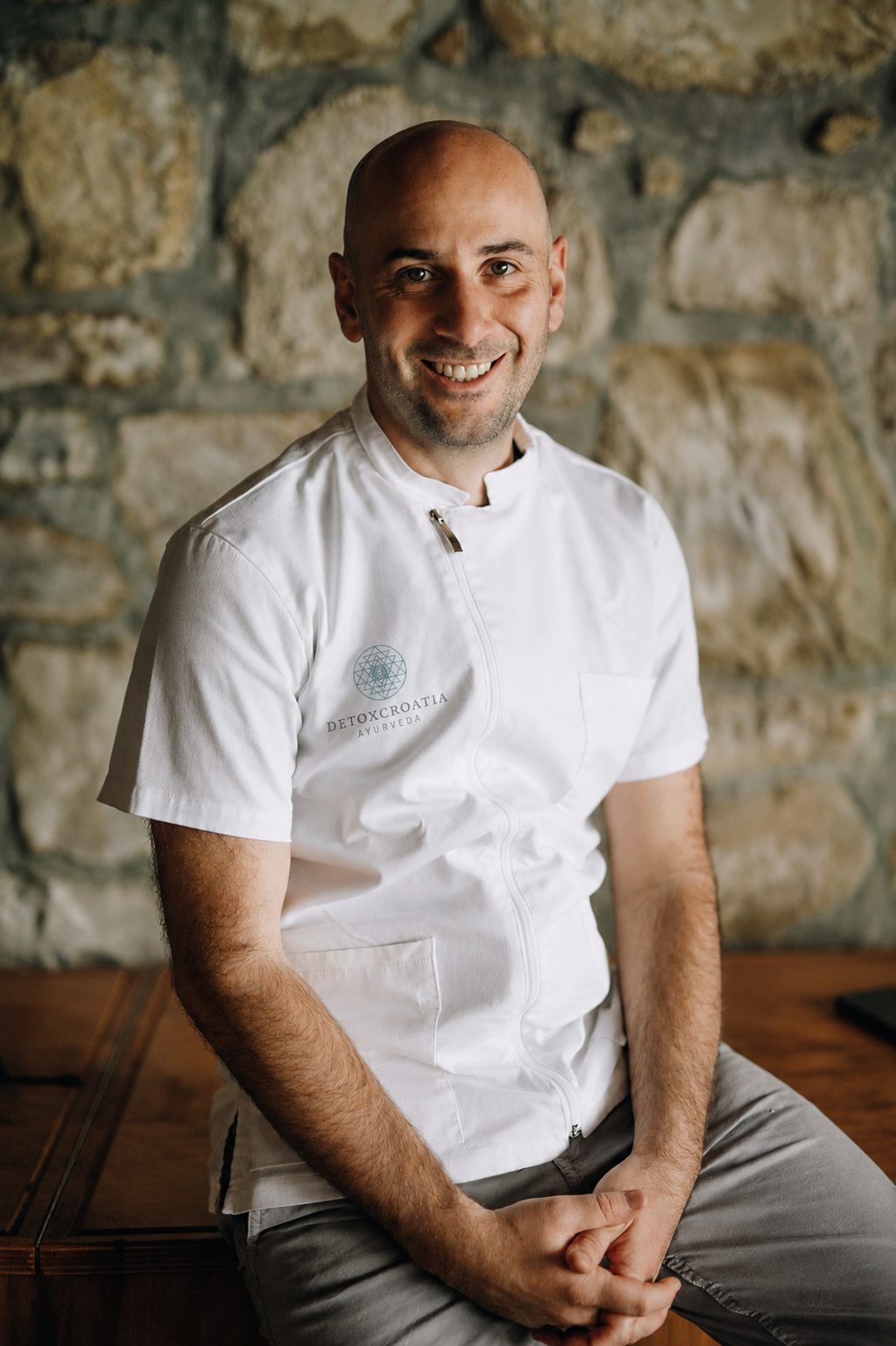
Branko Marković, founder of Detox Croatia, is an Ayurvedic practitioner specialised in Panchakarma and Rasayana therapy. He studied Ayurveda through the Middlesex University of London and College of Ayurveda program, followed by clinical training and practice in India, France, Norway and Croatia. His work is shaped by more than 15 years of individual consultations and guided Panchakarma retreat programs.
The program is not based on a fixed schedule applied equally to everyone. Food, therapies, rhythm, rest and conversation are adjusted daily according to what the client is showing.
Some clients want community. Some need privacy. Both are respected. The goal is not to perform a program. The goal is to create the conditions where the nervous system finally feels safe enough to stop staying awake.